Category: Concepts

  • History

    History

    This extraordinary painting of Fra Luca Paccioli, shown below, painted by J de Barbari (1440 -1516) gives us a historical summary of many fascinating elements of the Golden Proportion under the following five headings.

    luca

    1. Pentagon
    2. Euclid
    3. Platonic Solids
    4. The Dodecahedron
    5. Fra Luca Paccioli

    The painting shows Paccioli (5) with an intense gaze on the suspended solid transparency (3) relating it to a text and a drawing on a slate (2) showing Euclid’s name.

    The transparent figure that Fra Luca Paccioli is studying is a composite of the platonic solids (3).

    The Pentagon

    The pentagon is a 5 sided figure (Penta meaning 5.) It is seen in the painting as the surface of the dodecahedron which is one of the Platonic solids. The famous building, the pentagon which is the seat of government in the USA is built in this shape. Inscribed within is the 5-pointed star, a pentagram, frequently seen in military ensignia. Superimposed on this pentagram is a golden proportion gauge showing a smaller to larger division of the Golden Proportion on a line (a chord) of the pentagon as seen below.

    Pentagon, 5 Pointed Star

    The ancient Greeks, starting with Pythagoras in about 550 BCE, were very interested in the way the the diagonals of the pentagram (the 5 pointed star) intersect each other in the golden proportion and gave the first formulation of the golden proportion in the following terms.

    ” The diagonals of the pentagram cut each other in division of extreme and mean ratio”

    This latter expression is the inspired title of a book by Roger Hertz-Fischler printed in 1987 in which he traces the history of the Golden Proportion in great detail. The book ranges from ancient Greece across the globe, embracing many different cultures and, from the time of Pythagoras, to the modern day.

    Huntley in his book The Divine Proportion [Dover 1970] describes the reverence which the ancient Greeks felt for the Golden Proportion as symbolized in the Pentagram. They felt that it had a mystical significance and revered the pentagram as the symbol of their secret society. The Pythagoreans were both fascinated and perplexed by the intersecting cords of the Pentagon giving a double Golden Mean Proportion, details of which are described under, “what’s special“.

    Euclid

    slate

    A slate with Euclid’s name.

    The bottom left of Pacioli’s painting, shows a slate with Euclids’s name. Pacioli seems to be relating the text he is reading to the Slate with Euclid’s name on it. The slate probably refers to Euclid’s treatise of thirteen books on Geometry which he called “The Elements”. Completed in Alexandria in 300 BCE, it is still considered to be the best book ever written on elementary mathematics or ever likely to be written (Coxeter 1980) .

    parthenon

    The Parthenon. The facade is a Golden Rectangle.

    His treatise “the Elements” laid the foundation for the PLATONIC SOLIDS which represent the culmination of the discoveries that marked the epic age of Greek Mathematics. Euclid in 300BCE, put the finishing touches to the theory of the Golden Proportion and showed how to construct the Golden Proportion with compass and ruler only.

    There seems to be no doubt that Greek architects and sculptors incorporated this ratio in their artifacts. The proportions of the Parthenon shows the way the Greeks deliberately used the Golden Proportion (Huntley, 1970). In the early days of the present century, it was suggested that the Greek letter ‘phi’,, the initial letter of Phidias’ name, who was one of the ancient Greek famous Sculptors, would be adopted to designate the Golden Proportion.

    The Platonic Solids

    solids

    The Five Platonic Solids

    The transparent figure that Fra Luca Paccioli,in the HISTORY page, is studying is a composite of the platonic solids. The 5 Platonic solids are illustrated above with some of their properties. Euclid, 300 BCE and the Ancient Greeks, in their love for geometry, called these five solids, the atoms of the Universe. In the same way that we today believe that all matter, is made up of combinations of atoms so the Ancient Greeks (also) believed that all physical matter is made up of the atoms of the Platonic Solids and that all matter also has a mystical side represented by their connection with earth, air, fire, water and aether. Similar to our modern atom which shows a nucleus surrounded by electrons in orbits creating spheres of energy, the Greeks felt that these Platonic solids also have a spherical property, where one Platonic Solid fits in a sphere, which alternately fits inside another Platonic Solid, again fitting in another sphere. Paccioli is studying in a transparency the way in which one solid fits inside another. The concept of one sphere fitting inside another sphere is surprisingly frequently seen in different cultures but manifesting in uniquely different ways, as will be accurately described in the author’s forth coming book.

    The Pythagoreans knew that there were only five regular convex solids, the tetrahedon, cube, octahedron, icosohedron and dodecahedron and each one could be accurately circumscribed by a sphere. The dodecahedron had twelve regular faces, which corresponded to the twelve signs of the Zodiac; it was therefore a symbol of the universe for the Pythagoreans. Moreover, each one of these faces is a pentagon. Euclid described these five regular solids in Book Thirteen of the Elements. They are associated with the name of Plato because of his efforts to relate them to the important entities of which he supposed the world to be made. Plato discusses them in his various dialogues.

    The corners of the octohedron fit in the centre of thr cube faces. The icosohedron can be inscribed in an octohedron, so that each vertex of the former divides an edge of the latter into the Golden Proportion The icosohedron and the dodecohedron are also uniquely connected with the Golden Proportion by virtue of three intersecting golden rectangles which fit into both. In modern times it has been discovered that the shape of many of the viruses is either icosohedron or cube.

    The pentagon (the five-sided figure) is closely related to the icosohedron and its complement the dodecohedron. The diagram shows clearly how the dodecahedron is made up of twelve pentagonal faces. The Icosohedron is made up of triangular faces, but also grouped in 5 as seen at the vertex where 5 triangular faces come together.

    Whereas these later 2 mentioned platonic solids are seen in the 5 pointed star the remaining three platonic solids can be found in the 6 pointed star.

    The Dodecahedron

    The dodecahedron is one of the 5 Platonic solids with 12 pentagonal surfaces.

    dodecahedron

    footballOne of the 5 platonic solids is described by Plato in the “The Phaedo” (110 B.) where he refers to a ball with 12 pentagonal faces and which is the precursor to our modern football, still made with a variable number of pentagons as shown in the adjacent photograph.

    The dodecahedron contain 3 Golden Proportion intersecting rectangles, as seen in the adjacent diagram. This later theme has inspired the Laban School of Dancing to base its movements within the rectangles.

    The icosahedron fits well as an inscribed solid within the dodecahedron.

    12hedron2

    Fra Luca Paccioli

    The platonic solids and the Golden Proportion underwent a revival during the Renaissance as shown in the painting by J. De Barbari, of Fra Luca Paccioli. This painting illustrates 5 different facets of the Golden Proportion.

    A copy of a painting of Fra Luca Paccioli, studying The Platonic Solids and Euclid’s work, has been used as the front cover of Robert Lawlor’s book “Sacred Geometry – Philosophy and Practice”, which contains two excellent chapters on the Golden Proportion. This painting has also been included in an article on dental aesthetics written by the author in the USA journal of Prosthetic Dentistry Sep 1978 and Dental Aesthetics Indepentent Dentistry. London The Golden Proportion Jan 1997.

    Leonardo da Vinci, together with his mentor, Fra Luca Paccioli, one of the leading scientists and mathematicians of the Renaissance, were both fascinated with the Golden Proportion and together wrote a dissertation on the golden Proportion. The dissertation was printed in 1509 under the title of the Divine Proportion”, reprinted in Milan in 1896, (Gardner Pelican 1961), the frontispiece of which is shown below.
    devine

    The Divine Proportion frontispiece illustrated by Leonardo da Vinci

    devine2

    Leonardo da Vinci’s famous study of the square and the circle


    Amongst Da Vinci’s abundant studies is his famous squaring of the circle. So fascinating that variation have become the logo of a number of organisations, each with slight modifications. It shows the figure of a man contained within a square as well as within a circle. Its connection with the Golden Proportion is that the centre of the circle is in the umbilical navel which divides the body into a larger part and a smaller upper part, the two parts in the Golden Proportion’ as in the above copy of the study.

  • Mathematics

    Mathematics

    The Unique Properties

    The question must arise as to why the golden proportion is special – and more importantly, is there any difference between the Golden Proportion and another pleasing proportion? A brief study of figures below will answer this question.

    two-math-equations

    Thus the proportion of the smaller to the greater is the same as the proportion of the greater to the whole. The division of the line by point C thus represents a point of equilibrium between these two proportions. If you move the point a fraction one way or the other, then you have two proportions which are neither the same nor are they in equilibrium. The only time that these two proportions are the same is when they are Golden.

    This point of division is a mathematical confirmation of how the eye senses the balance of this magical proportion that appears so frequently in nature and art.

    The Bilateral Form

    The bilateral form is the most common of the subtle variations of the Golden Proportion, seen in nature and art.

    bilateral

    We see in the figure above that A:B = B:C = 1.000 : 0.618

    If we now align the mid-points of B and C as in figure above and place them one just above the other, we then find that there is now a “larger-to-whole” relationship and that on either side of the midline we have the “larger to the smaller” simple relationship.

    Patterns of this bilateral form are frequently found in the beauty of nature and works of art. The two examples of the photograph frame shows the midline marked and a smaller to larger relationship either side.

    The same patern is seen in the examples of tarton cloth as well as the Spanish Royal Palace and the headlights of the motor car.

    Click images below to enlarge

    Dental

    bilateral-07We have already seen that the incisors are in the Golden Proportion to each other and this photograph of teeth shows the bilateral variation, whilst the gauge and grid indicate the bilateral neutral space.

    bilateral-08The Golden Mean gauge shows a strong indication of the correct position of the Canine/Premolar dominant corner of the arch. This latter corner thereby influences the antero posterior position of the front teeth. (Related to the width of smile and eye measurement).

    It is interesting to visualize the anterior aesthetic segment featured against the backcloth of this neutral space framed by the lips. Notice the way the car headlights are in the same proportion to the distance between them as the neutral space is to the width of the arch that shows in the smile.

    Geometric Progression

    The sequence of the Basic Golden Proportion numbers is a geometric progression as follows:-

    0.618 1

    1

    1.618

    2.618

    4.236

    6.854

    11.09

    etc

    etc

    2 Snaill pic.

    2 Snaill pic.

    where each term is multiplied by 1.618 or divided by 0.618 as seen in the cascade of the Fibonacci Series.

    Besides the golden Proportion there are many other geometric progressions in nature. An example of two different progressions is shown in the two snail shells.

    The musical octave scale of doubling is also a geometric progression.

    humtleyThe cover of Huntley’s book with the title of the “Divine Proportion” shows yet another spiral, which Huntley calls a logarithmic or equiangular spiral. It is generated by a continues line cutting the sites of the main triangle in the Golden Proportion and then subsequent sides.

    The three remarkable photos below are extraordinary in that both Corbusier and Picasso appear to have incoporated, in architectural and art form, the identical Golden Proportion Grid as designed by the author for use in dentistry.


    Click imageĀ aboveĀ to enlarge

  • The Fibonacci Series

    The Fibonacci Series

    The line below shows a part of the Fibonacci series, from 21 to 89, to scale, with 2 Gauges superimposed on adjacent sections of the series to demonstrate that the parts are in the Golden Proportion.
    Golden Mean Gauge seen on the right.

    No consideration of the Golden Proportion can be complete without mention of the Fibonacci Series which is the complementary view of the Golden Proportion as illustrated above by the 3 Golden Mean Gauges. These numbers are also abundant in the beauty of nature and teeth.

    Definition

    In this series of numbers each term is the sum of the previous two terms as follows:

    0

    1

    1

    2

    3

    5

    8

    13

    21

    34

    55

    89

    etc.


    The division of any two adjacent numbers gives the amazing Golden number e.g.
    34 / 55 = 0.618 or inversely 55 /34 = 1.618.

    It is called the Fibonacci series after Leonardo of Pisa or (Filius Bonacci), alias Leonardo Fibonacci, born in 1175, whose great book The Liber Abaci (1202) , on arithmetic, was a standard work for 200 years and is still considered the best book written on arithmetic. It was the principal means of demonstrating and introducing the enormous advantages of the Hindu Arabic system of numeration over the Roman System.

    Leonardo’s reputation amongst scholars was deservedly great. It was so outstanding that King Frederick II, visiting Pisa in 1225, held a public competition in mathematics to test Leonardo’s skill and he was the only one able to answer the questions (Huntley 158).

    fibbon1One of the most spectacular examples of the Fibonacci Series in nature is in the head of the sunflower.

    Scientists have measured the number of spirals in the sunflower head. They found, not only one set of short spirals going clockwise from the centre, but also another set of longer spirals going anti clockwise, These two beautiful sinuous spirals of the sun flower head reveal the astonishing double connection with the Fibonacci series.


    pineapple-fibonacci-300


    a. The pairs are always adjacent numbers in the Fibonacci series

    e.g. one pair could be 21 and 34 and the next pair could be 34 and 55

    b. The adjacent numbers divided yield the Golden Proportion

    34 / 55 = 0.618 or 55 / 34 = 1.618


    The New Scientist Dec. 81 featured on its cover a daisy head showing the double spiral. The article then went on to discuss the Fibonnaci series, showing other examples of the double spirals in nature and comparing them to computer generated double spirals. The writers also postulated an explanation for the way plants’ growth illustrates the Fibonacci series in the position and spacing of the leaves (Phylotaxis.)

    Muslim Art

    muslimaths

    The Muslims allow no illustrations of any of God’s creations and so they were obliged to resort to mathematics to find ways of decorating their places of worship The Fibonacci series features extensively in Islamic decorations. A simplified indication of how a theme could be developed is shown here. The figure above shows 3 diagrams which are the recognisable numbers of the Fibonacci Series in the top line, left side.

    The first double digit number is 8 + 5 = 13 but the 13 has been reduced to 3 + 1 = 4 similarly the next double digit 8 + 9 = 17 has been reduced to 8 etc etc . The process called Kabalistic reduction is a frequently used method of manipulating numbers. The next line shows the alternate numbers selected- Excluding 9. From this line a pattern was generated as seen in the 3 figures, related to the number sequence. From this was built the final decorative pattern.

    muslimartThe adjacent picture shows a design featuring the pentagons and hexagons used in the Mosque. which were developed out of the connections between the Fibonacci series,and the Golden Proportion. The influence and interconnections between Muslim art the Golden Proportion, the polygons, the Vedic Hindu Square and the Cabbala number system, are beautifully illustrated in the “Language of Pattern” by Alburn, Smith, Steel and Walker published by Thames and Hudson.

    Mathematics

    The Fibonacci Cascade

    fif17The series of numbers below shows a Geometrical progression on the left hand side, where each number, starting from 1, is multiplied by 1.618. On the right hand side the first number is divided by 0.618 giving the identical result for each line. It is most extraordinary to see yet a 3rd simple progression running through the geometric series and that is an arithmetic series arrived at by adding the products of multiplication together as follows:-

    Add 1.618 to 2.618 = 4.236 which added to 2.618 = 6.854 etc etc. And this number is the addition of the previous two terms which is non other than the famous Fibonacci Series.

    We have thus one progression of numbers, arrived at by three different methods- two geometric and one arithmetic. The two geometric progressions are arrived at by multiplying each term by 1.618 or dividing by 0.168.

    Multiplication by 1.618

    Division by 0.618

    1 x 1.618 = 1.618

    1 / 0.618 = 1.618

    1.618 x 1.618 = 2.618

    1.618 / 0.618 = 2.618

    2.618 x 1.618 = 4.236

    2.618 / 0.618 = 4.236

    4.236 x 1.618 = 6.854

    4.236 / 0.618 = 6.854

    6.854 x 1.618 = 11.09

    6.854 / 0.618 = 11.09

    The Mathematical Key

    There are different ways to express the simple mathematics of the Fibonacci series.

    A mathematician would easily understand that all this stems from the following formula:-

    1

    —–

    =

    1.618

    0.618

    The Universe
    ————- = The Universe + 0.618

    0.618

    1

    ——

    = 1.618 or Universe + 0 .618

    0.618

    Where unity implies the ultimate unity

    The unity of the Universe divided by ‘something’ is equal to the unity of the universe plus ‘something’.

    mathkey1

    The smaller is to the larger as the larger is to the whole
    The Quadratic expression originates here.

    mathkey


    Fibonacci Association

    society


    Phylotaxis

    fibbon3Phylotaxis is the study of the ordered position of leaves on a stem.( Phyllos-leaf taxis order). (filo pastry– thin leaves of pastry) with particular reference to their repetition in the same alignment
    The Fibonacci series have been observed in phylotaxis and extensively studied in three different spiral arrangements .

    1. VERTICALLY. Where leaves on a stem demonstrate the Fibonacci Series as they spiral up the stem .
    2. HORIZONTALLY. Where the spirals are horizontal like on the flat head of the sunflower.
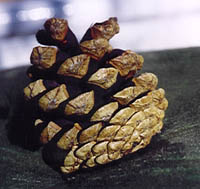
    3. TAPERED OR ROUNDED, like the tapered pine cones or the rounded Chrysanthemums or pineapples which also show a double set of spirals as in the adjacent pictures.

    fibbon2When these double sets of spirals have been counted, the numbers of spirals were found to be the adjacent Fibonacci numbers. Different numbers with different plants. Any textbook discussing mathematics in nature will include numerous examples.
    Brian Goodwin in his book, ‘How the Leopard changed its spots’, discusses Phyllotaxis at length and describes a model of phylotaxis produced by two French scientists Douady and Couder. They also managed to reproduce the double spirals of the similar to those of the sunflower by computer.
    Brian Goodwin further asks about Phylotaxis. “What is the inherent nature of the simple rules that govern this diversity. What are we looking at when we see such a magnificent variety of plants and flowers?”

    The study of Phylotaxis is a branch of biology that seeks the answers to these questions. The connection between phylotaxis and the Golden Proportion has engendered volumes of literature examining these questions. Surprisingly, as recent as 1998, a large magnificent tome on phylotaxis called “Symmetry in Plants” was published as a multidisciplinary study by 44 scientists, all leaders in their fields, including chapters by botanists, mathematicians crystallographers and molecular geneticists.

    Phylotaxis-The positions of leaves.

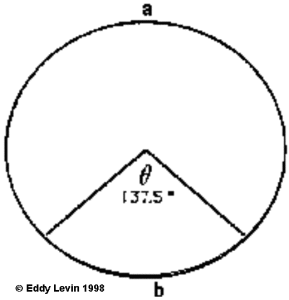
    fibbon4The leaves on a stem are positioned over the gaps between the lower leaves as they spiral up the stem. What is most remarkable about this spiral spacing, is that irrespective of species, the rotation angle tends to have only a few values. By far the most common of which is 137.5 o (Goodwin). This is considered an efficient arrangement to allow maximum sunlight to reach each set of leaves. This angle is non other than the Golden Proportion related to the perimeter of a circle as in the adjacent figure.

    It is the ratio between the perimeter of a circle where the larger part A, is to the smaller part B, as the larger part A is to the whole A+B. Our old familiar Golden Proportion premise here seen in yet another guise.

    The other example of the Golden Proportion is concerned with the number of leaves between one leaf and the next one directly overhead and the number of rotations before this position is reached.

    Some trees like Elmwood and basswood, the leaves along a stem seem to occur alternately on two opposite sides and we speak of 1/2 phyllotaxis. In the beech and hazel the passage from one leaf to the next is I/3 of a turn.

    oak and apricot 2/5 phylotaxis
    poplar and pear 3/8
    willow and almond 5/13
    these are all recognisable as alternate Fibonacci numbers. {Coxeter}

    We have already seen that the number of double spirals of the sunflower head are also Fibonacci numbers. The spirals have perhaps moved from the vertical plane to the horizontal plane.

    Sunflower
    The Fibonacci numbers also appear when we examine the number of petals of certain common flowers e.g.

    Iris 3 petals Daisy 34 petals
    Primrose 5 petals michaelmas daisy 55 petals
    Ragwort 13 petals michaelmas daisy 89 petals

    A brief search at the literature will soon reveal on abundance of further interesting studies on the Fibonacci Series.