Author: Dr. Eddy Levin

  • Golden Proportions in Teeth

    Golden Proportions in Teeth


    Tooth to Tooth Relationships

    The first Golden Proportion relationship, and the most important to be discovered, is a simple tooth to tooth Golden Proportion as shown above This shows the Golden Mean Gauge superimposed on a photograph of teeth showing that the width of the central incisor is in the Golden Proportion to the width of the lateral incisor. Similarly, the Gauge shows the lateral incisor is in the same Golden Proportion to the canine in the adjacent photo and the canine is in the Golden Proportion to the first premolar.

    The Diagnostic Grid

    the-diagnostic-gridThe four front teeth, from central incisor to premolar are the most significant part of the smile and they are in the Golden Proportion to each other. This phenomenon has been combined in a grid which can be used to assist us in perfecting the aesthetics of the eight front teeth. The adjacent diagram shows such a grid in the mouth with the front teeth clearly shown in the demarcations predicted.

    Note also that the grid lines up with the corner of the mouth (i.e. the end of the smile) and the dominant corner of the arch, predicting both positions.
    The widths of the spaces for the teeth are all in the Golden Proportion to each other.

    the-diagnostic-grid

    The number in the solid circle refers to the width of the central incisor. There are 7 grids to accept all widths of central incisor from 7 to 10 mms in steps of 1/2 mms.The grid also shows a number in a dotted circle which refers to the width of the smile.

    The Lip Line

    In the relaxed face, where the teeth are not touching together (when the lower jaw is in the rest position with free way space present) the lip line divides the lower third of the face into the Golden Proportion. The space between the bottom of the nose and the bottom of the chin is divided by the lip line into a “chin to lip line” (the larger part) and a smaller part the “lip line to under the nose” The smaller to the larger is in the Golden Proportion as illustrated above. These photographs show how the Golden Mean Gauge could be used in prosthetics to assist in determining the height of the incisors. If used in conjunction with phonetics and disclusion, there should be no “incisal edge” position problems. Incidentally, you may notice that some photographs of people smiling look something more  like a grimace or a snarl. Why ? Because the teeth are clenched together  rather than teeth apart, with freeway space between the jaws. This is also commonly called a grin rather than a smile. Smile, grin, snarl is the order.

    Width of arch showing in the Smile

    Pictures of any pleasant smile would show that the teeth do not extend right to the corners of the mouth but actually stop some distance from them. Thus there is an area of neutrality or darkness between the teeth and the corner of the smiling mouth. Between these two neutral spaces lies the anterior aesthetic segment. The neutral space lies between the dental arch and corner of the smiling mouth. It is a dynamic space which appears in a broad smile, constantly changing with different expressions. It can be defined as a bilateral space bounded laterally by the corner of the smiling mouth and medially by the arch. In the aesthetically pleasing smile the spaces between the corner of the mouth and the dental arch form a backdrop in which the anterior aesthetic segment is featured. The anterior aesthetic segment is in the Golden Proportion to the width as illustrated in the following paragraphs.

    width-of-arch-face

    Notice that in the photograph of the grid in the mouth, the edge of the grid lines up with the corner of the smile. This is another compound Golden Proportion showing that the width of ALL the 8 front teeth together are in the Golden Proportion to the width of the smiling lips. The anterior aesthetic segment, from 1st premolar to 1st premolar, is highlighted against the backdrop of the smiling lips, with two neutral parts laterally between lips and teeth. The white of the 8 front teeth is in the Golden Proportion to the width of the smile.

    Childrens drawings

    The most primitive ancient drawings of the face is also representative of the earliest drawings of children. Two dashes for eyes and a curve for the smiling mouth surrounded by a circle for the face as above in fig i, ii, iii, iv). Psychiatrists have confirmed the importance of the mother’s smile and its effect upon a very young child.

    childrens-drawings-01

    This child’s drawing has some fascinating features, which are of relevance to dental aesthetics. It indicates the important aesthetic landmarks which are represented by the ends of these apparently casual dashes. (The dash representing the eye is terminated laterally by the outer canthus of the eye. Medially it is the lateral aspect of the inner canthus or the end of the visible white eyeball.)

    The distance between the two eyes is the distance between the ‘EYE WHITES’.

    childrens-drawings-02

    They are beautifully interrelated in the Golden Proportion as shown in the photo of eyes above. This can be seen as a diagram in figure iii, where AB:BC in the Golden Proportion.

    Proportions Between Teeth and Smile

    In the drawings of older children the eye-dashes become circles and the lips are apart (Fig iii).

    proportions-teeth-smile-05 proportions-teeth-smile2

    We are thus presented with a new group of fascinating Golden Proportions that are helpful in prosthodontics. Note that the lips apart drawn in figure iii do not extend right to the corner of the mouth they actually stop some distance from them. Thus there is an area of darkness or neutrality between the teeth and the corner of the smiling mouth which is one of the most important factors in giving prosthesis a natural appearance.

    proportions-teeth-smile-03

    This again is shown in photo where the gauge, with one point on the midline, the other on the width of the smile shows the middle point on the buccal surface of first premolar. The Golden Mean Gauge shows that the corner of the arch divides the smile into a larger tooth part and a smaller neutral space and gives us another guide as to how to arrange the visual effect of this important corner. The same phenomenon is also illustrated in the figure below where the edge of the Grid lines up with the edge of the smile and the 4 teeth end at this position.

    proportions-teeth-smile-04

    In the aesthetically pleasing smile the spaces between the corners of the mouth and the dental arch form a backdrop in which the anterior aesthetic segment is featured. This is a frequent variation of the Golden Proportion which can be seen in more detail the bilateral form.


    Eyes to Teeth

    The WHITE of the eyes AB is in the Golden Proportion to the space between the eyes BC as seen in the children’s photo of eyes fig(iv) below.

    proportions-teeth-smile-05

    From this we can conclude that the WHITE width FG of the Anterior Aesthetic Segment is in the Golden Proportion to the WHITE of the eyes AB, as follows:

    By measurement it will be found that the width of the smiling lips from one corner of the mouth to the other is equal to the distance between the bridge of the nose plus the width of the eye, AC=DE (fig iv).

    Eyes

    Smaller

    .618

    Eyes

    AB

    Bridge

    BC

    Larger

    ——–

    =

    —-

    =

    —— =

    —

    =

    ————

    =

    —

    =

    ——-

    Larger

    1

    Bridge

    BC

    Eye+ Bridge

    AC

    Whole

    Smile

    FG

    teeth in Smile

    Larger

    —

    =

    —————

    =

    ——-

    DE

    width of Smile

    Whole

    BC Bridge = FG Teeth showing in Smile.

    AC Eye + Brdge = DE Width of Smile.

    Eyes & Smile

    BC – Bridge – Larger

    FG – Teeth in Smile – Larger

    —————————-

    =

    —————————–

    AC- Eyes+Bridge – Whole

    DE – Whole Smile – Whole

    BC (Bridge) = FC (Teeth in Smile)

    and AC (Eyes + Bridge) = DE (Width of Smile)

    Dental Literature Review of the Golden Proportion

    REFERENCES

    The application of the Golden Proportion to dental aesthetics was first written about by the author in 1978. Those humble beginnings have sown the seeds of a proliferation of Golden Proportion studies undertaken in three main directions, prosthodontic, surgical and orthodontic.

    Winston Senior, an eminent orthodontist in Manchester, UK, was the first orthodontist to appreciate the application of the Golden Proportion to orthodontics. It is with thanks to his enthusiastic lectures and case reports that so many orthodontists have taken a strong interest in the application of the Golden Proportion. In his most recent article he shows how ideal dental /facial aesthetics can be planned by combining the Golden Proportion with cephalometric analysis, plastic surgery and dental restorations. In the same article he shows a Golden Proportion relationship of the width between the buccal surfaces of the two upper canines to the width between the disto buccal corners of the upper first molars as in fig. INSERT FIG 9 senior

    Ricketts 1982 showed numerous cephalometric tracings of orthodontic landmarks in the Golden Proportion. He also showed amazing growth patterns in the Golden Proportion which radiated from fixed cephalometric points.

    Dr McArthur 1985 wrote an article “Maxillary and Mandibular Teeth Widths” in which he explains that the average ratio of upper central incisor to lower central incisor is 1.62. The author’s response to this observation, published in the Journal of Prosthetic Dentistry was to thank Dr Mcarthur for another good example of the Golden Proportion.
    Shoemaker in 1987 wrote a series of articles promoting the use of the Golden Proportion as an adjunct to cosmetic Dentistry.

    Amoric 1989 in his article “Le nombre d’or” showed many Golden Proportions in cephalometric tracings at various stages of facial growth and also included geometrical propositions.

    The Annals of Plastic Surgery 1989 include a fascinating study by Kawakami et al who investigated the Golden Proportion balance between eyes, nose and mouth in the facial appearance of typical Japanese individuals and, comparing the ratios to Caucasians, each ratio was then used for pre and post-operative aesthetic analysis using Moire’ topography.

    Dr Jack Preston 1993, although initially critical of the application of the Golden Proportion,. has since been influenced by the studies of Stephen Marquardt, and is now in total support of the concept *Dr. Preston Jack. Personal communication, 1998. Marquardt developed a Golden Proportion Pentagon Grid for Facial plastic surgery. Preston nevertheless showed a very close Golden Proportion relationship between the lower lateral incisor and the upper central incisor in his article, above.

    Dr Yosh Jefferson 1996 illustrates an article in the Journal of General Orthodontics with many Golden Proportion diagrams and computer generated photographs giving an ideal picture of the whole head. His work is also supported with cephalometric tracings.

    In contrast Gillen 1994 measured the widths of the incisors and stated that there was no Golden Proportion correlation. In his article he clearly states that his measurements were of “the entire widths of the incisors”, and acknowledges that the Golden Proportion phenomenon applies only to the widths as “seen”. This is such a common misconception that it is worth repeating that the Golden Proportion phenomenon applies to the widths of teeth as seen from the front and not the actual widths as measured.

    The author’s work on the Golden Proportion is now compulsory study in many dental schools.

    Rediscovery

    This principle of proportion has been known since the time of the Ancient Greeks, and has been rediscovered, described and studied by many famous people who applied it in their own fields. Artists, Borissavlievitch 1958; Leonardo 1490; Dürer, 1528; Ghyka 1964; mathematicians, Huntley 1970; Gardner, 1966; architects, Corbusier, 1961; musicians, Lendvai, 1971; scientists, Thompson, 1952; Coxeter, 1961 Gyorgi Doczi , Hambridge 1921; philosophers, Koestler, 1962; psychologists, Benyafield & Adams, 1976.. In the same way the author rediscovered the Golden Proportion and brought it to the attention of the dental world in 1978. Space only allows for the briefest reference to a few of the rediscoveries.

    Huntley, a modern mathematician, wrote an informative book called The Divine Proportion, the whole of which was devoted to the study of the Golden Proportion. The cover features a Golden Proportion spiral built on a triangle.

    La Corbusier, the highly acclaimed Parisian architect, developed a scale for architecture, the “modular”, which is based on the golden sections of the human body. His famous buildings were all based on the Golden Proportion. His book “La Modular” has been reprinted numerous times.
    It was known that Bela Bartok (1881-1945) used secret methods in his musical compositions. In a book written and researched by Lendavi it was revealed that he used the principles of the Golden Proportion extensively in his compositions.

    The Golden Rectangle and Dental Aesthetics

    The Golden Rectangle of the central incisors

    In its simplest form we can recognise the Golden Proportion as the division of a straight line into a larger and a smaller part with the Golden Proportion gauge as in the figure below:

    golden-rectangle

    In a Golden Proportion rectangle however the smaller part is at right angles to the larger part as shown below:

    golden-rectangle-02

    A frequent example of this is the ubiquitous plastic credit and telephone card all golden proportion rectangles.

    golden-rectangle-03

    We dentists find the proportions of the central incisor very beautiful, but we have not been able to find a Golden Proportion relationship between the obvious width and height. The problem was recently solved when Dr Stephen Marquardt, an eminent Oral surgeon in California, discovered that, “The HEIGHT of the central incisor is in the Golden Proportion to the WIDTH of the TWO central incisors.” as below:

    golden-rectangle-04

    The rectangle is determined by using the Golden Proportion gauge to measure the width of the two incisors and then to use the gauge to check the height, (there will soon be a grid available to do this easily, or the dimensions can be measured). This revelation has offered solutions to a host of dental aesthetic problems.

    The Golden Proportion shows us a way of confirming the widths of the incisors by measuring their heights. It is a formula for evaluating the horizontal against the vertical. Testing the phenomenon on photographs of attractive teeth shows a very close compliance between the theoretical and the practical. The gingival prostheses of Fig A, before and Fig B after, not only covers the unsightly exposed roots but also brings the gingival level down to establish a Golden Rectangle on the central incisors. With thanks to Detax for use of their photograph below, showing GINGAVAMOL artificial gingiva.

    golden-rectangle-05

    Fig A Before

    golden-rectangle-05a

    Fig B After


    It is very helpful to use the gauge to check the rectangle and then confirm with the grids. If both methods give the same indication you can be certain that the aesthetic result will be very satisfactory. The Golden Proportion grids show the inter-tooth relationship between the 8 teeth of the anterior aesthetic segment whereas the rectangle confirms the width of the incisors, related to their height. In the situation where it is necessary to close gaps between teeth with crowns, the combination of grid and rectangle will mutually confirm the aesthetic solution with a certainty that it will look attractive and natural. These grids are complementary to the Golden Proportion rectangle. The combination of the two gives a powerful tool to confidently determine good aesthetics.

    References

          LIST OF REFERENCES as above.       ALPHABETICAL

    K Alburn, JM Smith, S Steel, D Walker (1973). The Language of Pattern. Thames & Hudson, London.Benyafield and Adams (1976). The Golden Section Hypothesis. Brit J Psychol 67: 11-15.M Borissavlievitch (1958). The Golden Number. Alec Tiranti, London.Le Corbusier (1961). The Modulor. Faber and Faber, London.HSM Coxeter (1961). Introduction to Geometry. John Wiley & Sons Ltd, London.A Dürer (1528). Vier Bucher von menschlicher Proportion.M Ghyka (1964). Goemetrical Composition and Design. Alec Tiranti, London.M Gardner (1966). More Mathematical Puzzles and Diversions. Penguin Books, London.J Hambidge (1921). Dynamic symmetry. Scientific American 4:23.HE Huntley (1970). The Divine Proportion. Dover Publications, New York.A Koestler (1962). The Perfect Solids in The Watershed, Heinemann.R Lawlor (1982). Sacred Geometry Philosophy and Practice. Thames and Hudson Ltd, London.E Lendvai (1971). Béla Bartók An Analysis of his Music. Kahn & Averill, London.LeonardoE Levin (1978). Dental esthetics and the Golden Proportion. J Prosthet Dent 40(3):244-252.L Paccioli (1896). Divina Proportione. C Winterberg, Wien Graser.RM Ricketts (1981). The Golden Divider. J Clin Orthodon vol XV, No 11:752-759.DW Thompson (1952). Growth and Form. Cambridge University Press, Oxford.

  • Art

    Art

    MONDRIAN

    Mondrian
    Later Work. The Golden Mean Gauge illustrating the main landmarks.

    Mondrian seems to have spent his whole life drawing short black lines trying to find out why certain lines look good and others not so good as above. He is reported to have known about the Golden Proportion but made no claims that it influenced his work in any way. Looking at his extensive work on lines, it is clear that he was experimenting with what looked good. He went through many changes in style and retrospectively one can trace the dramatic evolution of his experiments in his early work with different line lengths and their positioning. He saw that certain line relationships looked better than others and constantly varied the arrangement to find what the best looked. In his later work we appreciate and enjoy a most beautiful balanced and dramatic painting. Gone are all the apparent immature fumbling lines. He never explained what he was searching for and neither what he found and neither described what the main features of his beautiful rectangles were. We as analytical scientists come along and reveal that he as an artist he included abundant Golden Proportions. We all have a strong sense of the Golden Proportion, but not only don’t we realise it but we don’t even realise how frequently, we naturally use it. Even our own ordinary handwriting is full of Golden Proportions. Every time we decorate a cake or make a flower arrangement, we unknowingly balance our design with the Golden Proportion Not, surprisingly one can detect many Golden Proportion relation ships between the searching lines in Mondrian’s early work, but they are nothing in comparison to the bold and beautiful rectangles drawn later. No wonder the Tate was willing to pay £2.8 million for Mondrian’s “Composition” with Red 1935 causing a public outcry. My letter published in the Evening Standard pg. 28 Dec 8 1999 however, encouraged the purchase.

    Early Work

    early-work

  • History

    History

    This extraordinary painting of Fra Luca Paccioli, shown below, painted by J de Barbari (1440 -1516) gives us a historical summary of many fascinating elements of the Golden Proportion under the following five headings.

    luca

    1. Pentagon
    2. Euclid
    3. Platonic Solids
    4. The Dodecahedron
    5. Fra Luca Paccioli

    The painting shows Paccioli (5) with an intense gaze on the suspended solid transparency (3) relating it to a text and a drawing on a slate (2) showing Euclid’s name.

    The transparent figure that Fra Luca Paccioli is studying is a composite of the platonic solids (3).

    The Pentagon

    The pentagon is a 5 sided figure (Penta meaning 5.) It is seen in the painting as the surface of the dodecahedron which is one of the Platonic solids. The famous building, the pentagon which is the seat of government in the USA is built in this shape. Inscribed within is the 5-pointed star, a pentagram, frequently seen in military ensignia. Superimposed on this pentagram is a golden proportion gauge showing a smaller to larger division of the Golden Proportion on a line (a chord) of the pentagon as seen below.

    Pentagon, 5 Pointed Star

    The ancient Greeks, starting with Pythagoras in about 550 BCE, were very interested in the way the the diagonals of the pentagram (the 5 pointed star) intersect each other in the golden proportion and gave the first formulation of the golden proportion in the following terms.

    ” The diagonals of the pentagram cut each other in division of extreme and mean ratio”

    This latter expression is the inspired title of a book by Roger Hertz-Fischler printed in 1987 in which he traces the history of the Golden Proportion in great detail. The book ranges from ancient Greece across the globe, embracing many different cultures and, from the time of Pythagoras, to the modern day.

    Huntley in his book The Divine Proportion [Dover 1970] describes the reverence which the ancient Greeks felt for the Golden Proportion as symbolized in the Pentagram. They felt that it had a mystical significance and revered the pentagram as the symbol of their secret society. The Pythagoreans were both fascinated and perplexed by the intersecting cords of the Pentagon giving a double Golden Mean Proportion, details of which are described under, “what’s special“.

    Euclid

    slate

    A slate with Euclid’s name.

    The bottom left of Pacioli’s painting, shows a slate with Euclids’s name. Pacioli seems to be relating the text he is reading to the Slate with Euclid’s name on it. The slate probably refers to Euclid’s treatise of thirteen books on Geometry which he called “The Elements”. Completed in Alexandria in 300 BCE, it is still considered to be the best book ever written on elementary mathematics or ever likely to be written (Coxeter 1980) .

    parthenon

    The Parthenon. The facade is a Golden Rectangle.

    His treatise “the Elements” laid the foundation for the PLATONIC SOLIDS which represent the culmination of the discoveries that marked the epic age of Greek Mathematics. Euclid in 300BCE, put the finishing touches to the theory of the Golden Proportion and showed how to construct the Golden Proportion with compass and ruler only.

    There seems to be no doubt that Greek architects and sculptors incorporated this ratio in their artifacts. The proportions of the Parthenon shows the way the Greeks deliberately used the Golden Proportion (Huntley, 1970). In the early days of the present century, it was suggested that the Greek letter ‘phi’,, the initial letter of Phidias’ name, who was one of the ancient Greek famous Sculptors, would be adopted to designate the Golden Proportion.

    The Platonic Solids

    solids

    The Five Platonic Solids

    The transparent figure that Fra Luca Paccioli,in the HISTORY page, is studying is a composite of the platonic solids. The 5 Platonic solids are illustrated above with some of their properties. Euclid, 300 BCE and the Ancient Greeks, in their love for geometry, called these five solids, the atoms of the Universe. In the same way that we today believe that all matter, is made up of combinations of atoms so the Ancient Greeks (also) believed that all physical matter is made up of the atoms of the Platonic Solids and that all matter also has a mystical side represented by their connection with earth, air, fire, water and aether. Similar to our modern atom which shows a nucleus surrounded by electrons in orbits creating spheres of energy, the Greeks felt that these Platonic solids also have a spherical property, where one Platonic Solid fits in a sphere, which alternately fits inside another Platonic Solid, again fitting in another sphere. Paccioli is studying in a transparency the way in which one solid fits inside another. The concept of one sphere fitting inside another sphere is surprisingly frequently seen in different cultures but manifesting in uniquely different ways, as will be accurately described in the author’s forth coming book.

    The Pythagoreans knew that there were only five regular convex solids, the tetrahedon, cube, octahedron, icosohedron and dodecahedron and each one could be accurately circumscribed by a sphere. The dodecahedron had twelve regular faces, which corresponded to the twelve signs of the Zodiac; it was therefore a symbol of the universe for the Pythagoreans. Moreover, each one of these faces is a pentagon. Euclid described these five regular solids in Book Thirteen of the Elements. They are associated with the name of Plato because of his efforts to relate them to the important entities of which he supposed the world to be made. Plato discusses them in his various dialogues.

    The corners of the octohedron fit in the centre of thr cube faces. The icosohedron can be inscribed in an octohedron, so that each vertex of the former divides an edge of the latter into the Golden Proportion The icosohedron and the dodecohedron are also uniquely connected with the Golden Proportion by virtue of three intersecting golden rectangles which fit into both. In modern times it has been discovered that the shape of many of the viruses is either icosohedron or cube.

    The pentagon (the five-sided figure) is closely related to the icosohedron and its complement the dodecohedron. The diagram shows clearly how the dodecahedron is made up of twelve pentagonal faces. The Icosohedron is made up of triangular faces, but also grouped in 5 as seen at the vertex where 5 triangular faces come together.

    Whereas these later 2 mentioned platonic solids are seen in the 5 pointed star the remaining three platonic solids can be found in the 6 pointed star.

    The Dodecahedron

    The dodecahedron is one of the 5 Platonic solids with 12 pentagonal surfaces.

    dodecahedron

    footballOne of the 5 platonic solids is described by Plato in the “The Phaedo” (110 B.) where he refers to a ball with 12 pentagonal faces and which is the precursor to our modern football, still made with a variable number of pentagons as shown in the adjacent photograph.

    The dodecahedron contain 3 Golden Proportion intersecting rectangles, as seen in the adjacent diagram. This later theme has inspired the Laban School of Dancing to base its movements within the rectangles.

    The icosahedron fits well as an inscribed solid within the dodecahedron.

    12hedron2

    Fra Luca Paccioli

    The platonic solids and the Golden Proportion underwent a revival during the Renaissance as shown in the painting by J. De Barbari, of Fra Luca Paccioli. This painting illustrates 5 different facets of the Golden Proportion.

    A copy of a painting of Fra Luca Paccioli, studying The Platonic Solids and Euclid’s work, has been used as the front cover of Robert Lawlor’s book “Sacred Geometry – Philosophy and Practice”, which contains two excellent chapters on the Golden Proportion. This painting has also been included in an article on dental aesthetics written by the author in the USA journal of Prosthetic Dentistry Sep 1978 and Dental Aesthetics Indepentent Dentistry. London The Golden Proportion Jan 1997.

    Leonardo da Vinci, together with his mentor, Fra Luca Paccioli, one of the leading scientists and mathematicians of the Renaissance, were both fascinated with the Golden Proportion and together wrote a dissertation on the golden Proportion. The dissertation was printed in 1509 under the title of the Divine Proportion”, reprinted in Milan in 1896, (Gardner Pelican 1961), the frontispiece of which is shown below.
    devine

    The Divine Proportion frontispiece illustrated by Leonardo da Vinci

    devine2

    Leonardo da Vinci’s famous study of the square and the circle


    Amongst Da Vinci’s abundant studies is his famous squaring of the circle. So fascinating that variation have become the logo of a number of organisations, each with slight modifications. It shows the figure of a man contained within a square as well as within a circle. Its connection with the Golden Proportion is that the centre of the circle is in the umbilical navel which divides the body into a larger part and a smaller upper part, the two parts in the Golden Proportion’ as in the above copy of the study.

  • Nature

    Nature

    Good proportion is an important element of beauty as seen in these pictures:

    Leaf

    Peacock feather

    Peacock feather

    A Golden Mean Gauge is superimposed on one of the dominant landmarks of the feather showing them to be in the Golden Proportion. There are at least 12 different Golden Proportions which can be identified on the dominant landmarks on the peacock feather. The peacock feather has been chosen because it has simple flat surfaces which lends itself to a clear and non-controversial Golden Proportion analysis.

    Bird

    Bird

    A Golden Mean Gauge is superimposed on the dominant colour seperations.


    Flower

    A Flower

    A Golden Mean Gauge is superimposed on a flower.

    moth

    Moth

    A Golden Mean Gauge is superimposed on a moth. The moth wing has been chosen because it has simple flat surfaces which lends itself to a clear and non-controversial Golden Proportion analysis.


    stipes

    Stripes

    A Golden Mean Gauge is superimposed on the stripes of the tail. The same applies to the stripes of the Zebra.


    flowers

    Flowers


    petal

    Petal


    insect

    Insect

    Two Golden Mean Gauges are superimposed on an insect showing compound golden proportions. Nature abounds in examples of many compound golden proportions in any situation.
  • Mathematics

    Mathematics

    The Unique Properties

    The question must arise as to why the golden proportion is special – and more importantly, is there any difference between the Golden Proportion and another pleasing proportion? A brief study of figures below will answer this question.

    two-math-equations

    Thus the proportion of the smaller to the greater is the same as the proportion of the greater to the whole. The division of the line by point C thus represents a point of equilibrium between these two proportions. If you move the point a fraction one way or the other, then you have two proportions which are neither the same nor are they in equilibrium. The only time that these two proportions are the same is when they are Golden.

    This point of division is a mathematical confirmation of how the eye senses the balance of this magical proportion that appears so frequently in nature and art.

    The Bilateral Form

    The bilateral form is the most common of the subtle variations of the Golden Proportion, seen in nature and art.

    bilateral

    We see in the figure above that A:B = B:C = 1.000 : 0.618

    If we now align the mid-points of B and C as in figure above and place them one just above the other, we then find that there is now a “larger-to-whole” relationship and that on either side of the midline we have the “larger to the smaller” simple relationship.

    Patterns of this bilateral form are frequently found in the beauty of nature and works of art. The two examples of the photograph frame shows the midline marked and a smaller to larger relationship either side.

    The same patern is seen in the examples of tarton cloth as well as the Spanish Royal Palace and the headlights of the motor car.

    Click images below to enlarge

    Dental

    bilateral-07We have already seen that the incisors are in the Golden Proportion to each other and this photograph of teeth shows the bilateral variation, whilst the gauge and grid indicate the bilateral neutral space.

    bilateral-08The Golden Mean gauge shows a strong indication of the correct position of the Canine/Premolar dominant corner of the arch. This latter corner thereby influences the antero posterior position of the front teeth. (Related to the width of smile and eye measurement).

    It is interesting to visualize the anterior aesthetic segment featured against the backcloth of this neutral space framed by the lips. Notice the way the car headlights are in the same proportion to the distance between them as the neutral space is to the width of the arch that shows in the smile.

    Geometric Progression

    The sequence of the Basic Golden Proportion numbers is a geometric progression as follows:-

    0.618 1

    1

    1.618

    2.618

    4.236

    6.854

    11.09

    etc

    etc

    2 Snaill pic.

    2 Snaill pic.

    where each term is multiplied by 1.618 or divided by 0.618 as seen in the cascade of the Fibonacci Series.

    Besides the golden Proportion there are many other geometric progressions in nature. An example of two different progressions is shown in the two snail shells.

    The musical octave scale of doubling is also a geometric progression.

    humtleyThe cover of Huntley’s book with the title of the “Divine Proportion” shows yet another spiral, which Huntley calls a logarithmic or equiangular spiral. It is generated by a continues line cutting the sites of the main triangle in the Golden Proportion and then subsequent sides.

    The three remarkable photos below are extraordinary in that both Corbusier and Picasso appear to have incoporated, in architectural and art form, the identical Golden Proportion Grid as designed by the author for use in dentistry.


    Click image above to enlarge

  • The Fibonacci Series

    The Fibonacci Series

    The line below shows a part of the Fibonacci series, from 21 to 89, to scale, with 2 Gauges superimposed on adjacent sections of the series to demonstrate that the parts are in the Golden Proportion.
    Golden Mean Gauge seen on the right.

    No consideration of the Golden Proportion can be complete without mention of the Fibonacci Series which is the complementary view of the Golden Proportion as illustrated above by the 3 Golden Mean Gauges. These numbers are also abundant in the beauty of nature and teeth.

    Definition

    In this series of numbers each term is the sum of the previous two terms as follows:

    0

    1

    1

    2

    3

    5

    8

    13

    21

    34

    55

    89

    etc.


    The division of any two adjacent numbers gives the amazing Golden number e.g.
    34 / 55 = 0.618 or inversely 55 /34 = 1.618.

    It is called the Fibonacci series after Leonardo of Pisa or (Filius Bonacci), alias Leonardo Fibonacci, born in 1175, whose great book The Liber Abaci (1202) , on arithmetic, was a standard work for 200 years and is still considered the best book written on arithmetic. It was the principal means of demonstrating and introducing the enormous advantages of the Hindu Arabic system of numeration over the Roman System.

    Leonardo’s reputation amongst scholars was deservedly great. It was so outstanding that King Frederick II, visiting Pisa in 1225, held a public competition in mathematics to test Leonardo’s skill and he was the only one able to answer the questions (Huntley 158).

    fibbon1One of the most spectacular examples of the Fibonacci Series in nature is in the head of the sunflower.

    Scientists have measured the number of spirals in the sunflower head. They found, not only one set of short spirals going clockwise from the centre, but also another set of longer spirals going anti clockwise, These two beautiful sinuous spirals of the sun flower head reveal the astonishing double connection with the Fibonacci series.


    pineapple-fibonacci-300


    a. The pairs are always adjacent numbers in the Fibonacci series

    e.g. one pair could be 21 and 34 and the next pair could be 34 and 55

    b. The adjacent numbers divided yield the Golden Proportion

    34 / 55 = 0.618 or 55 / 34 = 1.618


    The New Scientist Dec. 81 featured on its cover a daisy head showing the double spiral. The article then went on to discuss the Fibonnaci series, showing other examples of the double spirals in nature and comparing them to computer generated double spirals. The writers also postulated an explanation for the way plants’ growth illustrates the Fibonacci series in the position and spacing of the leaves (Phylotaxis.)

    Muslim Art

    muslimaths

    The Muslims allow no illustrations of any of God’s creations and so they were obliged to resort to mathematics to find ways of decorating their places of worship The Fibonacci series features extensively in Islamic decorations. A simplified indication of how a theme could be developed is shown here. The figure above shows 3 diagrams which are the recognisable numbers of the Fibonacci Series in the top line, left side.

    The first double digit number is 8 + 5 = 13 but the 13 has been reduced to 3 + 1 = 4 similarly the next double digit 8 + 9 = 17 has been reduced to 8 etc etc . The process called Kabalistic reduction is a frequently used method of manipulating numbers. The next line shows the alternate numbers selected- Excluding 9. From this line a pattern was generated as seen in the 3 figures, related to the number sequence. From this was built the final decorative pattern.

    muslimartThe adjacent picture shows a design featuring the pentagons and hexagons used in the Mosque. which were developed out of the connections between the Fibonacci series,and the Golden Proportion. The influence and interconnections between Muslim art the Golden Proportion, the polygons, the Vedic Hindu Square and the Cabbala number system, are beautifully illustrated in the “Language of Pattern” by Alburn, Smith, Steel and Walker published by Thames and Hudson.

    Mathematics

    The Fibonacci Cascade

    fif17The series of numbers below shows a Geometrical progression on the left hand side, where each number, starting from 1, is multiplied by 1.618. On the right hand side the first number is divided by 0.618 giving the identical result for each line. It is most extraordinary to see yet a 3rd simple progression running through the geometric series and that is an arithmetic series arrived at by adding the products of multiplication together as follows:-

    Add 1.618 to 2.618 = 4.236 which added to 2.618 = 6.854 etc etc. And this number is the addition of the previous two terms which is non other than the famous Fibonacci Series.

    We have thus one progression of numbers, arrived at by three different methods- two geometric and one arithmetic. The two geometric progressions are arrived at by multiplying each term by 1.618 or dividing by 0.168.

    Multiplication by 1.618

    Division by 0.618

    1 x 1.618 = 1.618

    1 / 0.618 = 1.618

    1.618 x 1.618 = 2.618

    1.618 / 0.618 = 2.618

    2.618 x 1.618 = 4.236

    2.618 / 0.618 = 4.236

    4.236 x 1.618 = 6.854

    4.236 / 0.618 = 6.854

    6.854 x 1.618 = 11.09

    6.854 / 0.618 = 11.09

    The Mathematical Key

    There are different ways to express the simple mathematics of the Fibonacci series.

    A mathematician would easily understand that all this stems from the following formula:-

    1

    —–

    =

    1.618

    0.618

    The Universe
    ————- = The Universe + 0.618

    0.618

    1

    ——

    = 1.618 or Universe + 0 .618

    0.618

    Where unity implies the ultimate unity

    The unity of the Universe divided by ‘something’ is equal to the unity of the universe plus ‘something’.

    mathkey1

    The smaller is to the larger as the larger is to the whole
    The Quadratic expression originates here.

    mathkey


    Fibonacci Association

    society


    Phylotaxis

    fibbon3Phylotaxis is the study of the ordered position of leaves on a stem.( Phyllos-leaf taxis order). (filo pastry– thin leaves of pastry) with particular reference to their repetition in the same alignment
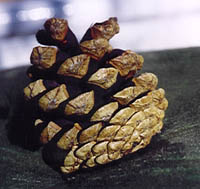
    The Fibonacci series have been observed in phylotaxis and extensively studied in three different spiral arrangements .

    1. VERTICALLY. Where leaves on a stem demonstrate the Fibonacci Series as they spiral up the stem .
    2. HORIZONTALLY. Where the spirals are horizontal like on the flat head of the sunflower.
    3. TAPERED OR ROUNDED, like the tapered pine cones or the rounded Chrysanthemums or pineapples which also show a double set of spirals as in the adjacent pictures.

    fibbon2When these double sets of spirals have been counted, the numbers of spirals were found to be the adjacent Fibonacci numbers. Different numbers with different plants. Any textbook discussing mathematics in nature will include numerous examples.
    Brian Goodwin in his book, ‘How the Leopard changed its spots’, discusses Phyllotaxis at length and describes a model of phylotaxis produced by two French scientists Douady and Couder. They also managed to reproduce the double spirals of the similar to those of the sunflower by computer.
    Brian Goodwin further asks about Phylotaxis. “What is the inherent nature of the simple rules that govern this diversity. What are we looking at when we see such a magnificent variety of plants and flowers?”

    The study of Phylotaxis is a branch of biology that seeks the answers to these questions. The connection between phylotaxis and the Golden Proportion has engendered volumes of literature examining these questions. Surprisingly, as recent as 1998, a large magnificent tome on phylotaxis called “Symmetry in Plants” was published as a multidisciplinary study by 44 scientists, all leaders in their fields, including chapters by botanists, mathematicians crystallographers and molecular geneticists.

    Phylotaxis-The positions of leaves.

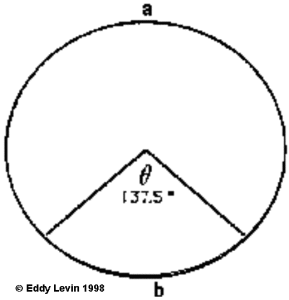
    fibbon4The leaves on a stem are positioned over the gaps between the lower leaves as they spiral up the stem. What is most remarkable about this spiral spacing, is that irrespective of species, the rotation angle tends to have only a few values. By far the most common of which is 137.5 o (Goodwin). This is considered an efficient arrangement to allow maximum sunlight to reach each set of leaves. This angle is non other than the Golden Proportion related to the perimeter of a circle as in the adjacent figure.

    It is the ratio between the perimeter of a circle where the larger part A, is to the smaller part B, as the larger part A is to the whole A+B. Our old familiar Golden Proportion premise here seen in yet another guise.

    The other example of the Golden Proportion is concerned with the number of leaves between one leaf and the next one directly overhead and the number of rotations before this position is reached.

    Some trees like Elmwood and basswood, the leaves along a stem seem to occur alternately on two opposite sides and we speak of 1/2 phyllotaxis. In the beech and hazel the passage from one leaf to the next is I/3 of a turn.

    oak and apricot 2/5 phylotaxis
    poplar and pear 3/8
    willow and almond 5/13
    these are all recognisable as alternate Fibonacci numbers. {Coxeter}

    We have already seen that the number of double spirals of the sunflower head are also Fibonacci numbers. The spirals have perhaps moved from the vertical plane to the horizontal plane.

    Sunflower
    The Fibonacci numbers also appear when we examine the number of petals of certain common flowers e.g.

    Iris 3 petals Daisy 34 petals
    Primrose 5 petals michaelmas daisy 55 petals
    Ragwort 13 petals michaelmas daisy 89 petals

    A brief search at the literature will soon reveal on abundance of further interesting studies on the Fibonacci Series.

  • Architecture

    Architecture

    We naturally enjoy the golden proportion divisions of the space of our monuments and homes.

    The famous Parisian architect, La Corbusier, wrote a book called “Le Modulor” as a guide to the use of the Golden Proportion in architecture. The cover of this book shows different views of the ladder grid in the Golden Proportion. We shall later see this ladder in numerous contexts, Link to Dental Grids, Geometric Progression, including the famous Fibonacci series of the numbers of nature.

    modulor
    Similar Dental and Picasso Grid:

    geometric3
    proportions-teeth-smile-04

    Examples

  • Design

    Design

    The golden proportion as seen in different designs

    Fashion

    The golden mean gauge shows that the dominant landmarks are in the golden proportion.


    The golden mean gauge shows that the dominant landmarks are in the golden proportion

    In Car Design

    Car manufacturers are most likely employ the most artistic designers they can find who intuitively use the golden proportion as shown in the thumbnails below.


    General

    All good design abound with examples of the Golden Proportion like the clothes or handwriting we have already seen. The more skilful the artist the closer his or her art and design conforms to the Golden Proportion as shown in the following pictures. The doninant landmarks are in the Golden Proportion.

  • Hand Writing

    Hand Writing

    We all have more knowledge of the Golden Proportion than we ever suspected. Our handwriting shows the Golden Proportion over and over. When we write, we place a horizontal bar in the capital (upper case) letters, A E F R B H P quite casually and without any thought. When these letters are enlarged and measured, we see that the horizontal bar divides the letter into a larger and a smaller part which is usually surprisingly close to the Golden Proportion, as seen in the letters B and E below. Similarly the horizontal bar of the T is also divided into the Golden Proportion.

    hand-writing

    In the same way, the artists quite naturally or instinctively used this proportion so it should not be too surprising to see the Golden Proportion appearing in the examples of arts and crafts.

    alphabetAll this despite the carefull training that we have all had to make the top and bottom half of the letters equal size as can be seen on the practice tables, right side[/vc_column_text][/vc_column][/vc_row]

  • Crop Circles

    Crop Circles

    Crop circle pictures by courtesey of Lucy Pringle

    The crop circles are huge, about 300 feet in diameter. The pattern is made by the difference between the standing crop and the flattened crop, but even the flattened stalks are very different from just ordinary bent over or trodden on stalks. Found mainly in fields of cereal, wheat, barley, rye etc The nodes on the stalks are often enlarged and the distance between the nodes is often increased. The novice, standing in the midst of a crop circle, may have no idea of the magnitude of this phenomena, a reflection of ordinary life, being in the midst of a cosmic event with no notion of what is happening around him or her. It is only when and if one is privileged to see the crop circle from a height, i.e. the top of a hill, from a helicopter, or a photograph from these heights, that the intricate pattern becomes clear. There are more and more reports coming in of their presence being found abroad but mostly they appear in Wiltshire, Southern England They have been reported for the past 100 years but the intensity, frequency and complexity seem to have increased ,year by year with a total number of many thousands. over the past 25 years.

    Amongst them, some are identified as fakes and a number of individuals take great pride in confessing their involvement, but most people would agree that the sophistication and sheer beauty of the geometry is way beyond the ordinary person’s ability
    As yet there are no totally plausible theories as to how they have been made.
    They are often reported as appearing overnight. The most popular theory to date is a connection with UFOs, but with negligible evidence.

    The adjacent pictures show the Golden Mean Gauge superimposed on the dominant features, showing the golden proportion between the large and the small segments. This is just another example of beauty in the world around us that is in the Golden Proportion.

    {Picture to be inserted showing the enlarged nodes and not bent at ground level and discolouration}

    Please enter your comments below which may be include at a later date, with or without your name
    Links to crop circle websites[/vc_column_text][/vc_column][/vc_row]